
RPGJS Joins Cloudflare for Startups: AI, GUI Generation, and Multiplayer
RPGJS has joined Cloudflare for Startups. Here is what it means for RPG Studio: better AI generation, an integrated assistant, GUI creation, and the future of low-latency multiplayer.
RPGJS Joins Cloudflare for Startups
RPGJS has joined Cloudflare for Startups.
This is an important step for RPG Studio because it gives the project more room to build the next layer of the product: stronger AI-assisted creation, more automation inside the editor, and a future multiplayer architecture that can run with very little configuration for creators.
The short version is simple: Cloudflare helps make two major directions more realistic for RPG Studio.
- AI acceleration: better content generation, a native assistant in the editor, and future GUI generation.
- Multiplayer infrastructure: a path toward low-latency online RPG and MMORPG features without asking creators to manage servers themselves.
These are large goals. They will not all appear at once. But joining the program gives RPGJS a stronger technical base for building them.
Why AI Generation Needs to Evolve
RPG Studio already includes AI-assisted workflows, but the current model has to evolve.
The reason is the map editor itself has changed. RPG Studio is no longer only placing flat tiles on a grid. The terrain system now supports more advanced editing: terrain morphology, digging, walls, organic shapes, and richer map structures.
That means the AI model also has to understand this new way of building maps.
The previous generation approach is no longer fully aligned with the current terrain system. The next step is to make AI generation work with the actual structure of the editor: terrain, elements, events, and gameplay logic together.
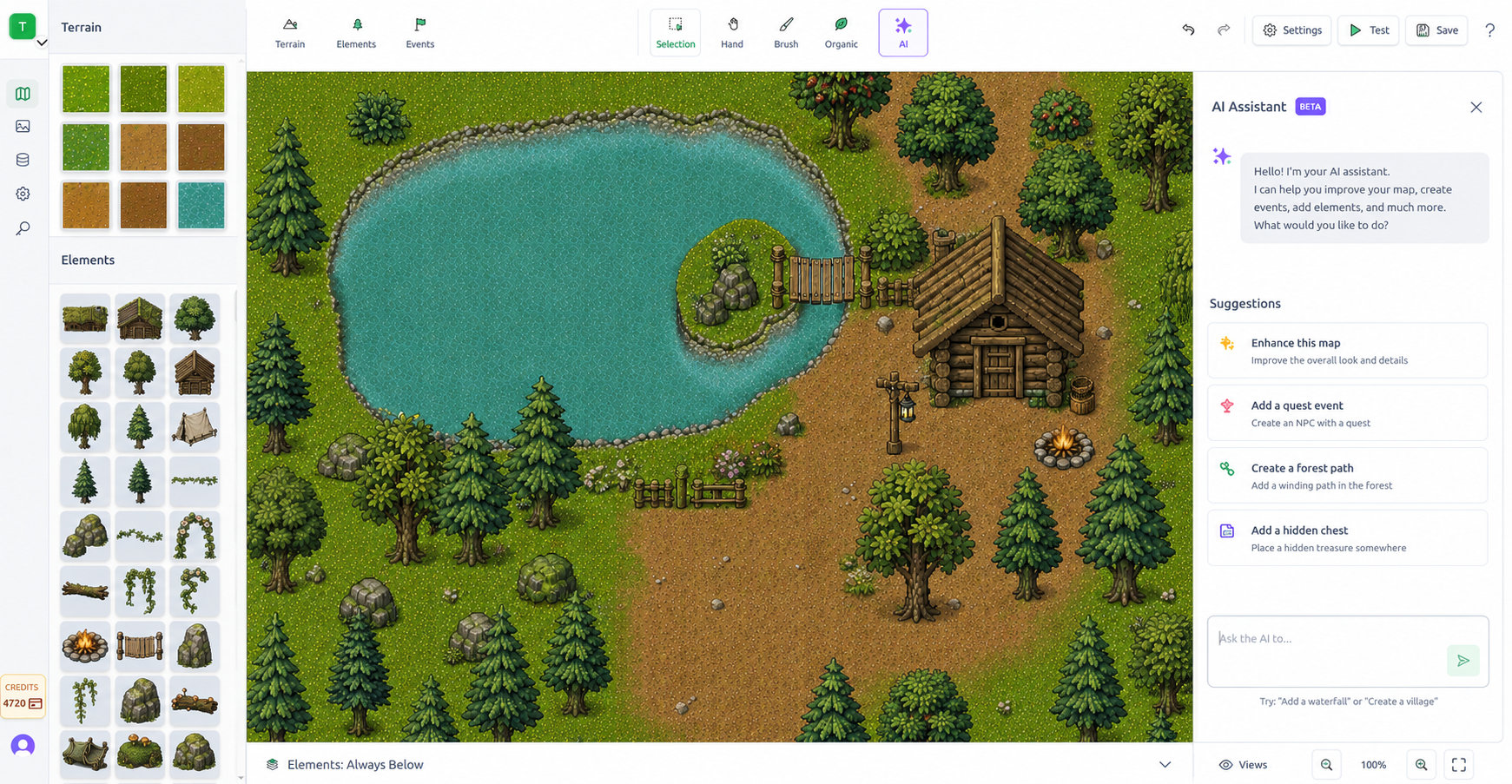
This image is a mockup and a simple representation of the direction. The final result may be different.
The goal is not just to generate a pretty map.
The goal is to generate content that can be edited, extended, and reused inside a real RPG project.
For example, AI should be able to help with:
- improving an existing map;
- creating terrain that fits the new morphology system;
- adding paths, forests, lakes, walls, caves, or villages;
- placing elements in a way that still works with gameplay;
- creating event ideas that match the map;
- helping the creator iterate instead of restarting from scratch.
This is the direction RPG Studio is moving toward: AI that understands the editor, not AI that only produces isolated assets.
A Native Assistant Inside RPG Studio
Today, it is already possible to use coding agents such as Codex or Claude Code with RPG Studio through the API.
That workflow is powerful, especially for developers. An agent can help create maps, add events, generate content, update data, and continue the project with code when needed.
But the next step is to make this easier for everyone.
With Cloudflare’s developer platform, especially Cloudflare Agents, RPG Studio can move toward an assistant that lives directly inside the editor.
This matters because creators should not always need to leave the Studio, configure an external coding tool, or manually connect an API key just to get AI help.
The long-term objective is to let the assistant understand the current project and help at the right moment:
- “Improve this map.”
- “Add a quest event near this character.”
- “Create a forest path between these two areas.”
- “Turn this NPC into a merchant.”
- “Add a hidden chest with a condition.”
- “Create a simple combat encounter.”
- “Add a side quest with rewards.”
The event system is becoming very complete. There are more and more blocks for building real gameplay: dialogs, conditions, rewards, movement, interactions, combat logic, quests, and progression.
As this system grows, AI becomes more useful.
Not because it replaces the creator, but because it can reduce the friction of assembling gameplay. You keep control, and you can still modify everything afterward. The assistant becomes a faster way to create a first version, then refine it manually.
Generating Game Interfaces With AI
Another important direction is GUI generation.
RPG Studio should not only help create maps and events. It should also help create the interfaces that make a game feel complete: HUDs, menus, quest logs, inventory screens, dialog boxes, status panels, action menus, and custom game screens.
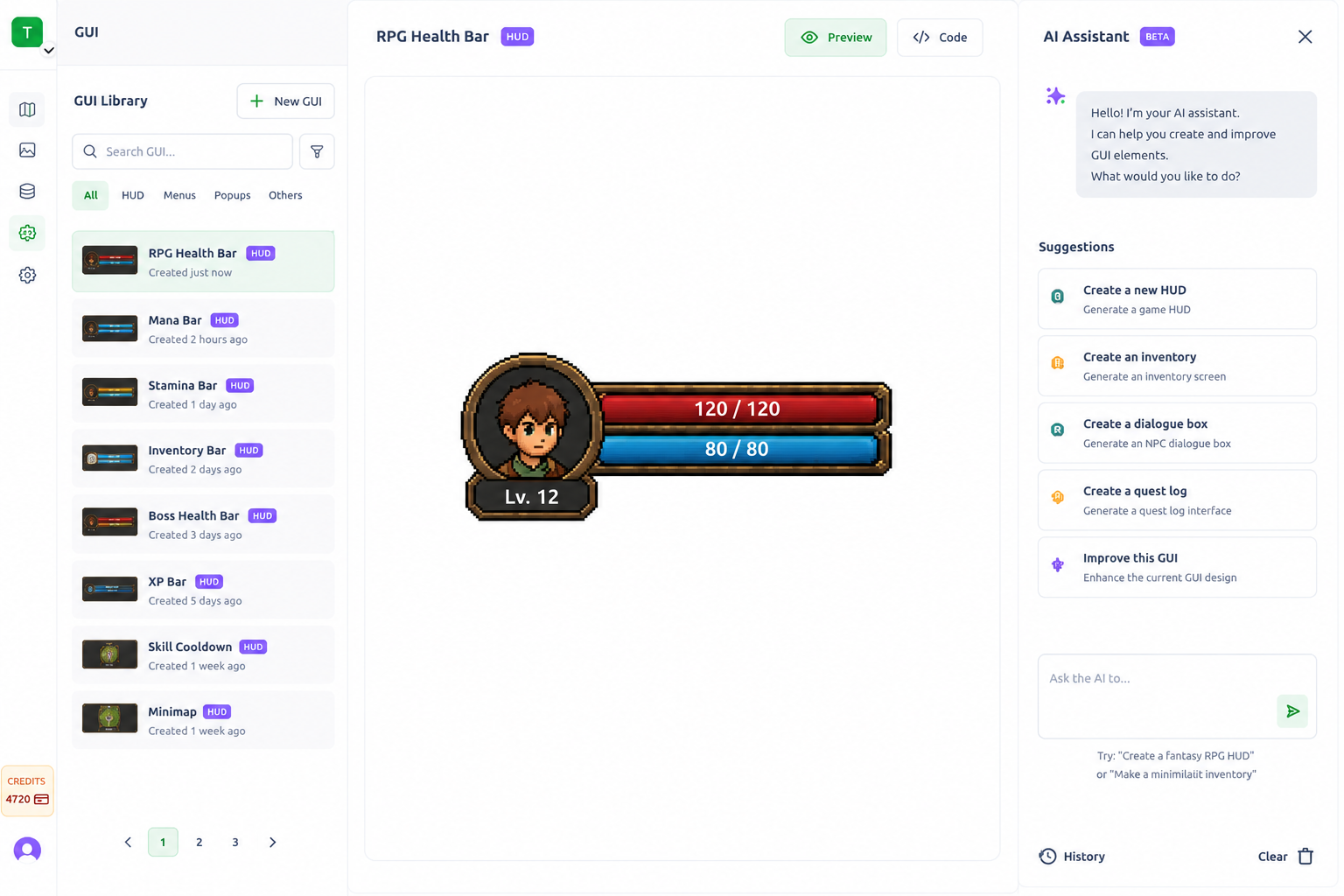
This image is a mockup and a simple representation of the direction. The final result may be different.
This is especially important because RPGJS uses Canvas Engine components for UI.
That means generated interfaces should not be locked inside a visual preview. The code can be recovered, adapted, and reused in a real game.
The idea is to make GUI creation flexible:
- generate a health and mana HUD;
- create a quest list;
- build an inventory menu;
- design a dialog box;
- create an action menu like in Stardew Valley;
- generate a custom RPG status screen;
- adapt the interface style to the game.
This could open a lot of possibilities.
One creator might want a farming RPG interface inspired by life-simulation games. Another might want an action-RPG HUD closer to Zelda-like games. Another might need a quest tracker, a crafting menu, or a multiplayer player list.
The goal is to make RPG Studio flexible enough to support those ideas while still giving creators access to the underlying code when they need it.
What This Means for License Holders
Joining Cloudflare for Startups also helps RPG Studio think differently about usage.
AI and multiplayer infrastructure can become expensive very quickly. The goal is to make these features generous for RPG Studio license holders, especially at the beginning, so creators can actually experiment with them instead of worrying about every request.
That does not mean unlimited usage forever. Large-scale AI generation and multiplayer hosting still have real costs.
But the Cloudflare program gives RPGJS more room to provide meaningful included usage for license holders while the product evolves.
For creators, the practical idea is:
- you buy a RPG Studio license;
- you get access to the Studio workflow;
- AI-assisted creation becomes easier to use directly inside the editor;
- future multiplayer features can start with a generous base;
- more advanced usage can later evolve into optional plans if needed.
The priority is to make creation feel natural first.
The Multiplayer Direction
The second major direction is multiplayer.
RPGJS has always been designed with RPGs and MMORPGs in mind. The open-source engine already has this identity: it is not only for small single-player prototypes, but also for online RPG experiences.
The challenge with RPG Studio is different.
If multiplayer is added to Studio, it should not require creators to manage servers, deployment, scaling, synchronization, or infrastructure. The experience should be closer to this:
Click a button, launch the online mode, and keep editing your game.
That is the kind of direction Cloudflare makes more realistic.
With Durable Objects, RPG Studio can explore a multiplayer architecture where game state, rooms, maps, and player interactions can be coordinated with low latency.
The first step would not be a full MMORPG with every possible feature. A reasonable first step would be simple multiplayer:
- players can join the same map;
- movement can be synchronized;
- map updates can be reflected in the game;
- events can be shared or triggered online;
- the foundation can later support more complex systems.
From there, the possibilities become much wider:
- PvP;
- cooperative quests;
- shared world events;
- player authentication;
- user management;
- live map updates;
- chat and social interactions;
- maybe voice or WebRTC-based communication later;
- potentially Web3 experiments for projects that need them.
This will take time. Multiplayer is not a small feature.
But Cloudflare gives RPGJS a serious foundation for building it progressively.
A Bigger Ambition for RPG Studio
RPG Studio already has a lot of possibilities today: map editing, terrain tools, events, database systems, media management, AI generation, and export workflows.
But the ambition is bigger.
The long-term vision is to let creators build many kinds of games with RPGJS:
- classic RPGs;
- action RPGs;
- Zelda-like adventures;
- farming or simulation games;
- story-driven games with quests;
- online RPGs;
- eventually MMORPG-like projects.
This also means the engine can keep evolving. Map systems can improve. Combat modes can expand. UI generation can become more flexible. Multiplayer can become part of the workflow. AI can assist not only with content, but also with gameplay structure.
Joining Cloudflare for Startups does not magically build all of this overnight.
But it does give RPGJS the infrastructure, credits, and technical direction needed to move faster toward that future.
RPG Studio is becoming more than an editor.
It is becoming a cloud workspace for building RPGs with visual tools, code, AI, and eventually multiplayer working together.