Publish and Play: Experimental MMORPG Hosting Is Now Live
RPGJS Studio can now deploy a multiplayer game server in a few seconds, keep game content up to date while it runs, and provide the foundation for larger online worlds.
Publish and Play: Experimental MMORPG Hosting Is Now Live
The first version of the RPGJS Studio MMORPG system is now available.
It is still experimental. This first public phase is meant to show how the system behaves with real projects, real players, and real usage. Your feedback will help identify what works well, what needs to be improved, and how the infrastructure performs under different conditions.
The most important part is already in place: you can deploy an online RPG server without configuring or managing the server yourself.
From a Project to an Online Server in One Click
Deploying a multiplayer game usually requires several technical steps. You have to prepare a server, configure the environment, publish the game, connect the client, monitor the process, and decide how the server will be updated.
RPGJS Studio handles that first deployment workflow for you.
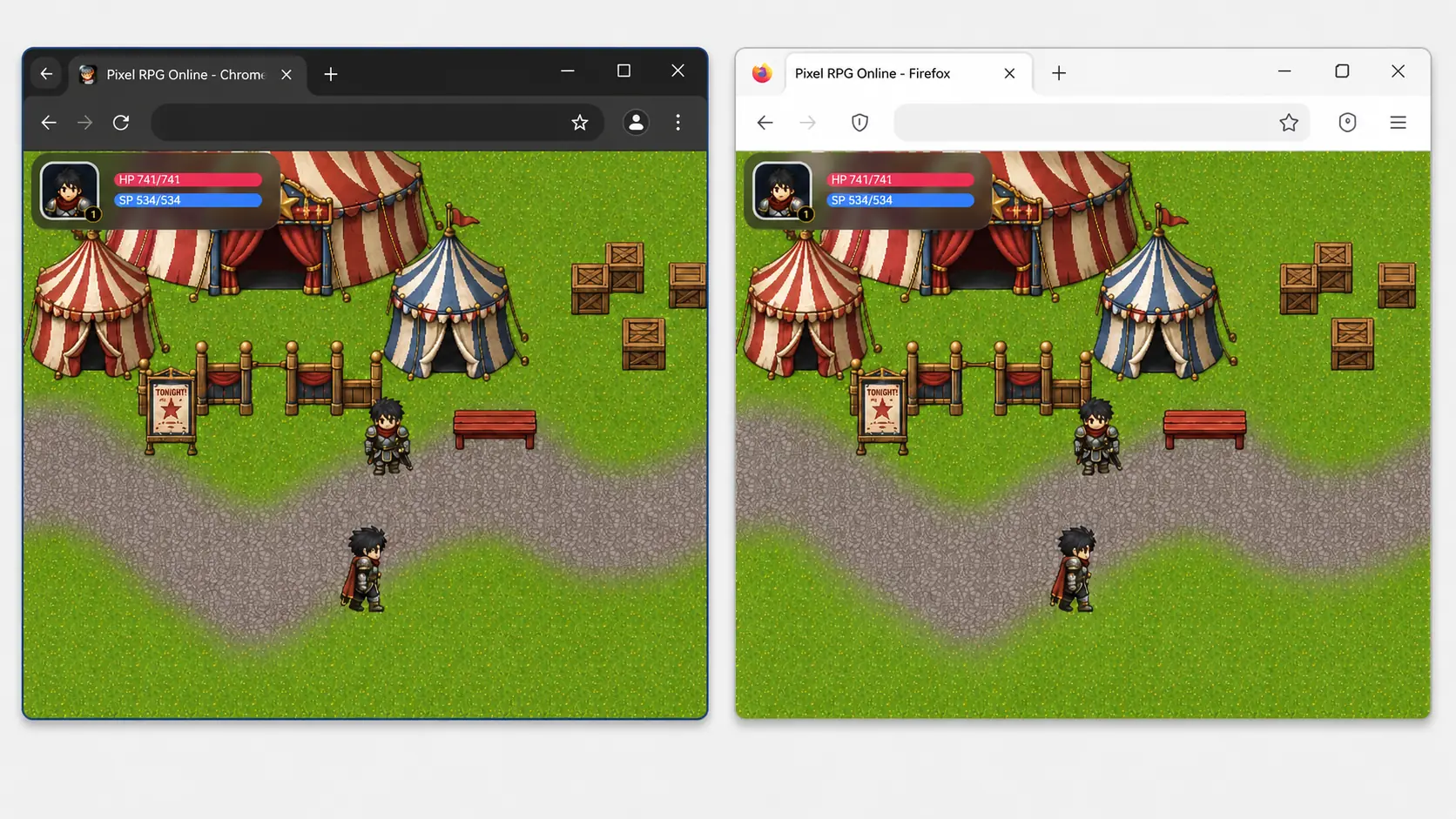
Click Publish and play MMORPG, wait a few seconds, and then join the running game server. There is no server configuration to prepare first and no deployment pipeline to build.

Open the World view, then click Publish and play MMORPG to deploy the server and launch the online game.
This makes the first multiplayer test much more accessible:
- Create your world in RPGJS Studio.
- Click Publish and play MMORPG.
- Wait for the server to start.
- Open the game and play online.
The goal is not only to make deployment faster for developers. It is to let creators test an online world even if they have no programming or server administration experience.
Update the World Without Restarting the Server
An online world rarely stays unchanged. Maps evolve, events are corrected, dialogs are rewritten, and new content is added while players already have progress in the game.
With the new deployment system, updating Studio content is designed to update the running game as well. You can modify content such as maps and events without manually restarting the MMORPG server.
This is important because a content update should not reset the entire world. The server keeps running, while the new content is loaded without intentionally discarding active state or saved data.
For creators, this means a shorter loop:
- edit a map or an event in Studio;
- publish the update;
- let the running game receive the new content;
- continue testing without rebuilding the server from scratch.
This workflow builds on the live-update architecture introduced with RPGJS v5, where maps and events can be updated at runtime instead of requiring a complete server restart.
Free to Test During the Experimental Phase
The experimental MMORPG system is currently accessible to everyone. You do not need an RPGJS Studio license, and you do not need to write code to try it.
This open testing period is temporary. It exists so the system can be observed under real conditions and improved from actual feedback.
The intended model will change after the experimental phase. In the future, access to the RPGJS Studio creation workflow—especially World Builder and developer tools—is expected to require an RPGJS license.
The RPGJS engine itself will remain free and open source. The license concerns the hosted Studio tools and the managed workflow around creation and deployment, not the ability to build an RPGJS game directly with code.
What “Massively Multiplayer” Requires
Launching a server is only the first step toward an MMORPG. A massively multiplayer world also needs an architecture that can distribute work as the number of connected players grows.
Every individual map has a practical player capacity. That capacity depends on the gameplay, the number of synchronized entities, event activity, network traffic, and the work the server has to perform for each player. The current experimental phase will help measure those limits with real games instead of relying only on theoretical assumptions.
The longer-term scaling model is based on dividing the world into independent areas. One map could run on one server instance, while another map runs on a different instance. Moving between them would remain invisible to the player.
It should also remain invisible to the creator. You build one connected world in Studio; the platform handles how its maps are distributed behind the scenes.
In simplified form:
One game world, multiple map servers, one continuous experience for the player.
This does not make a single map infinitely scalable. It allows the complete world to grow horizontally by distributing maps and their players across separate server instances. More advanced strategies for very crowded maps can then be developed and tested over time.
This map-oriented approach follows the same principle as stateful multiplayer infrastructure such as Cloudflare Durable Objects: separate coordinated instances can each own part of an application’s state and scale independently.
What Comes Next
The current release provides the deployment and runtime foundation. The complete MMORPG creation experience will arrive progressively.
Planned areas include:
- an in-game chat system;
- new event blocks that can interact with other connected players;
- PvP gameplay;
- shared multiplayer interactions and world events;
- player accounts and authentication;
- user administration tools;
- persistent player and world saves;
- more controls for operating a live online game;
- stronger scaling across maps and server instances.
These systems need to be added carefully. Multiplayer features affect state, security, persistence, moderation, performance, and the way events behave for every connected player. The experimental phase provides the base needed to build and validate them one step at a time.
Help Shape the MMORPG System
RPGJS Studio can now take a project from the World Builder to a running multiplayer server with a single action. That is the milestone of this first release.
The system is not presented as finished. It is available now so creators can test it, report issues, share real use cases, and help reveal the performance requirements of different kinds of games.
Over time, the objective is clear: give anyone the tools to create a multiplayer RPG without programming knowledge and, just as importantly, without having to operate game servers.
Click Publish and play MMORPG, bring another player into the world, and help build the next stage of RPGJS multiplayer.