
RPGJS v5: Open-Source JavaScript RPG Engine
Explore RPGJS v5, the open-source JavaScript RPG engine beneath RPGJS Studio, with a customizable client, backend flexibility and live game updates.
RPGJS v5: Open-Source JavaScript RPG Engine
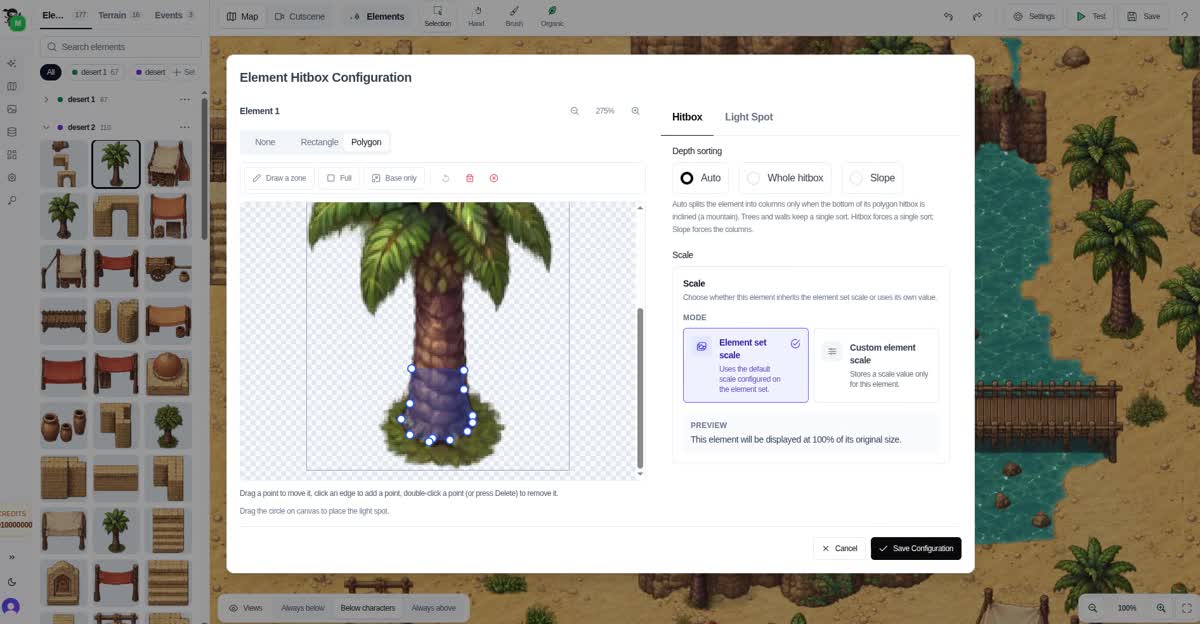
RPGJS Engine is the code-first, MIT-licensed foundation. RPGJS Studio is the visual workflow for building maps, events and assets before exporting RPGJS-compatible source.
RPGJS v5 is not a small iteration. It is a deep rebuild of the engine, and in many ways, it represents the version that fully unlocks the long-term vision behind RPGJS as an open-source framework for RPGs and MMORPGs on the web.
RPGJS v5 is now available in Beta. If you want to explore the engine directly, you can start with the documentation at v5.rpgjs.dev.
Version 4 was already solid. It proved the concept and made many projects possible. But it also had real limitations that made the engine harder to evolve over time. With v5, the goal was not just to add features. The goal was to correct structural issues, make the engine more adaptable, and provide a foundation that can scale with ambitious games.
Another reality is that this level of development would have been far more difficult without AI-assisted workflows. AI did not replace the engineering effort, but it clearly accelerated it. It helped push forward a much larger body of work and made it possible to move faster on a version that required significant architectural change.
v5 Fixes Two Core Problems from v4
From an engine design perspective, two major pain points stood out in RPGJS v4.
1. Client-side customization was too limited
In v4, you could build graphical interfaces and menus with JavaScript, but deeper customization quickly became difficult. As soon as you wanted to go beyond the expected workflow, friction appeared.
For example:
- Replacing or extending the default way UI components behaved was not always straightforward
- Working directly with canvas-level rendering logic could become complex
- Using your own map pipeline instead of the standard editor was possible in theory, but cumbersome in practice
That was a real limitation, because modern game development needs flexibility. A framework should not trap developers inside one editor or one way of building content. It should provide strong defaults, while still allowing teams to take control when they need custom tools, custom rendering, or custom content pipelines.
RPGJS v5 moves much further in that direction. The engine is designed to be easier to plug into external systems and to support more advanced customization on the client side.
2. Live production updates were not intrinsic to the engine
Another major issue in v4 was updating a live game world. Imagine a game already running in production, and an administrator wants to:
- add an event to a map
- adjust a scenario
- update map content in real time
In v4, that kind of workflow was possible only with additional effort and was not really built into the core logic of the engine.
In v5, this becomes much more natural thanks to HTTP-based update workflows. With a token system, an administrator can update maps and events at runtime without restarting the server. That changes a lot.
It means you can:
- push new scenarios while the game is live
- modify content without disrupting connected players
- connect the engine to an editor or admin backend in a clean way
This is one of the most important improvements in v5, because it makes the engine more practical for real online game operations, not just for development.
Built to Be Connected to Any Backend
One of the clearest design goals in RPGJS v5 is to make the engine easier to integrate with external backends and tools.
Today, the main backend built around this vision is RPGJS Studio. That part is not open source and is designed to let creators build games without dealing with infrastructure directly. But the engine itself is not tied to Studio.
That is the key point: anyone can connect RPGJS to their own backend.
This makes RPGJS v5 much more than a closed workflow. It becomes an open framework that can be embedded into different production stacks, editors, content pipelines, or administration tools.
Backend-Agnostic by Design
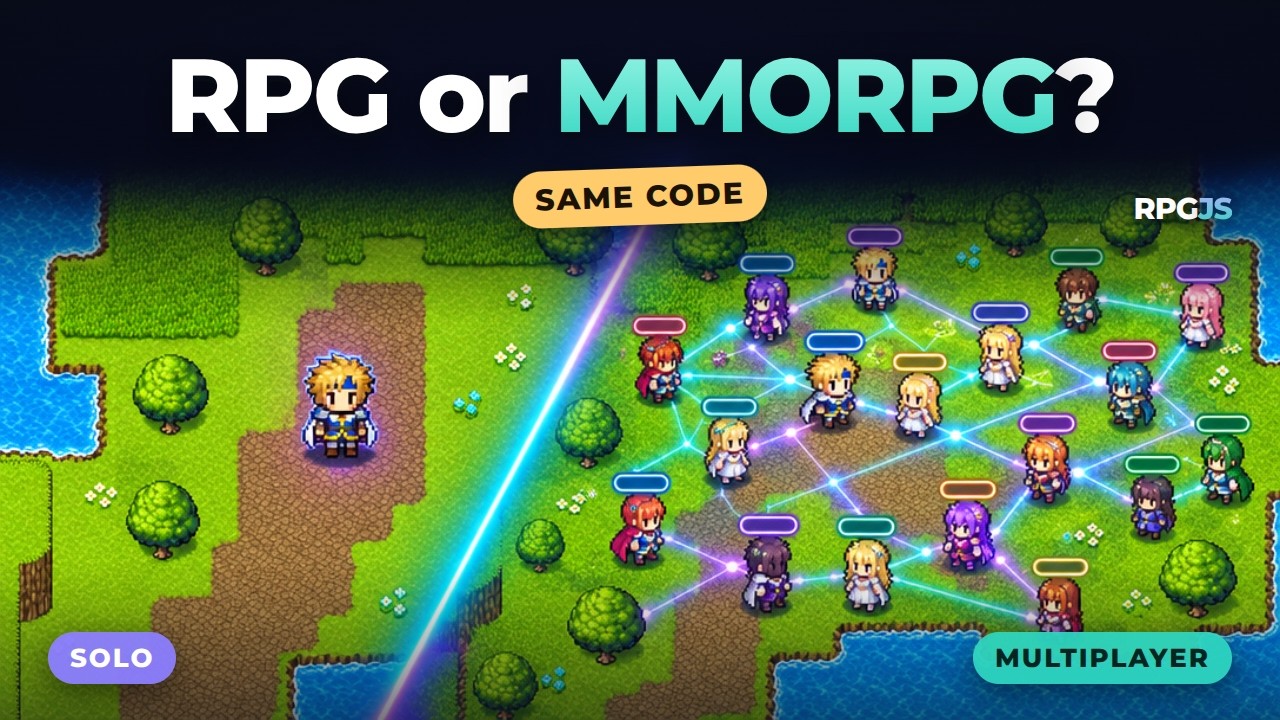
RPGJS v5 keeps the original promise of sharing code between different types of games. With the same foundation, you can still build:
- a single-player or small online RPG
- a larger MMORPG
But the backend story is now much more flexible as well.
The engine is based on Node.js and JavaScript, but it is no longer mentally tied to one rigid server model. You can integrate it with:
- Express
- Fastify
- Cloudflare Workers
- or other backend environments
The important part is the architecture: the engine is not forcing you into one deployment style, one transport layer, or one backend framework.
That same philosophy applies to persistence.
RPGJS v5 does not impose a specific database. It can use in-memory storage for performance, but beyond that, the persistence strategy is open. SQL, NoSQL, HTTP services, or custom storage layers can all fit depending on your project.
In practice, one recommended approach is to use HTTP requests for save and load operations, which gives teams full freedom to connect the engine to their own data systems.
A Flexible Snapshot Strategy for Saves
Saving game data should not be hardcoded for all projects in the same way, because an offline RPG and an MMORPG do not have the same needs.
RPGJS v5 embraces that reality with a more flexible save model based on snapshots of game state, including data such as:
- player position
- variables
- inventory and owned items
- other runtime state that must be restored later
The engine lets developers choose the save strategy that fits the game:
- local storage for a browser RPG
- remote persistence for an online game
- custom backend logic for more advanced cases
Again, the point is not to force one answer. The point is to provide the framework structure while leaving room for real production decisions.
A Real Framework for Web MMORPG Architecture
RPGJS v5 is not just a toolkit. It is a framework that already addresses hard problems that are usually ignored in ad hoc game prototypes.
It provides a foundation for:
- clear client/server separation
- automatic synchronization
- component-based insertion and extension
- client-side prediction
- server reconciliation
On the rendering side, it builds on Pixi.js, which means developers benefit from a performant graphics stack already suited for 2D web games. With modern browser capabilities such as WebGPU in the ecosystem, the client side is also positioned for stronger rendering performance.
The engine also fits the needs of modern devices and play styles, including support paths for:
- mobile controls such as joysticks
- gamepad-friendly experiences
- online world structures that can evolve over time
All of this matters because building a web MMORPG is not just about rendering a map and moving a sprite. The real difficulty is in the architecture.
Why AI-Generated Game Code Is Not Enough on Its Own
Today, many developers experiment with AI to generate web game code. That can be useful for prototypes, and in some cases, it works surprisingly well for early testing.
But most AI-generated game stacks are not designed as real MMORPG foundations.
They usually are not built for:
- performance at scale
- client-side prediction
- server reconciliation
- map-to-map session transfer
- distributing maps or zones across different servers
- live content updates without restart
- clean integration with external backends and admin tools
That is the difference between generated code and a real framework.
Without a framework, you may get something that works for a demo. But once the game needs to grow, change, receive new gameplay systems, or stay live in production, the limits appear quickly.
RPGJS v5 exists to solve that exact problem: provide the right foundation first, then let developers build faster on top of it, including with AI.
There is even now a dedicated skill and workflow designed to help code with AI on top of RPGJS itself. That is the right order of things: first, get the architecture right; then use AI to accelerate development on solid ground.
Open Source, Stronger Foundations
At its core, RPGJS v5 is about foundations.
It keeps what made RPGJS interesting in earlier versions, but it removes many of the bottlenecks that made deeper evolution difficult. It is more customizable, more backend-agnostic, easier to connect to external systems, and better suited to live online operations.
That is why v5 matters.
It is not just another version. It is a stronger open-source base for developers who want to build serious RPGs and MMORPGs on the web, with an engine that is designed to evolve, integrate, and scale.